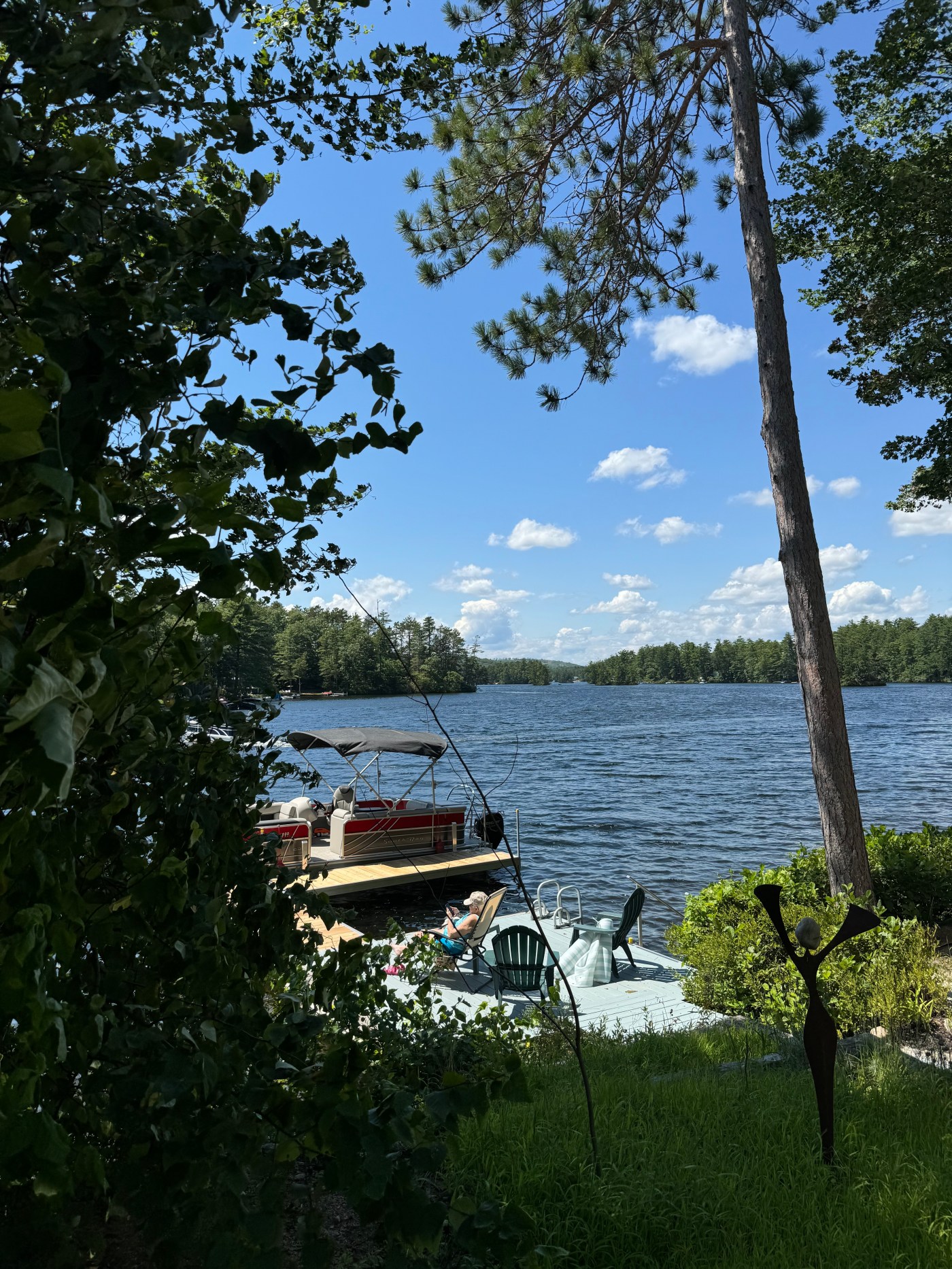
This is my fifth Maine Lake –lakes which I lived on, vacationed by, loved. Balch Lake is a large lake: approximately four miles long and more than 14 miles of shoreline. My beloved Parker Pond, the lake I left when my late wife’s health began failing eight years ago, was roughly one-quarter the size of Balch.
Balch Lake is not Parker Pond, which is an hour north west from here, nor is it the lakes of my childhood, or the island retreat where I vacationed for many summers as a young adult, but when I lean back in my Adirondack chair and close my eyes, the sound of a motor boat, the barking of a dog across the water, the cry of two loons in our cove, the breeze on my bare arms, and the deep, earthy smell of the lake transport me to those other havens.
I have been married less than six months to the woman who sits on the dock as I write this. We each came to this new relationship after thirty-plus years in previous happy marriages; both of our wives died in the same year, during, but not because of, the pandemic. As with my Maine lakes, the familiar and the new mingle. The known feeling of waking up in the morning with a loved one beside me. The unexpected pleasure she takes from assembling the cabinets that we ordered for our laundry room. Her delight in cooking; her impatience with the counters and tables piled high with frying pans, body lotion, and wine glasses – the flotsam from our merging households. The contentment of reviewing the day with someone who shared it.
Yesterday, my wife and I rode around our new lake in her pontoon boat, delivered from her previous camp on nearby Silver Lake, the cherished camp she passed on to her eldest son when we bought this one. She drove the boat slowly, for we have not yet learned the contours of the lake, although we studied maps and listened to the advice of neighbors and the suggestions of the woman at the marina where the boat was launched.
“Stay out of Stump Pond. Too shallow.”
“To get to your house, watch for the place where you will see several boats in a narrow passage, a sandbar between the islands, with boats anchored and people swimming and playing together.”
“Most of the shallow, rocky places have been marked with cairns.”
Balch Lake has a most irregular shape. It was formed over 100 years ago when a dam was built on the Little Ossipee River and the three lakes which had previously existed in these hills became one. As a result, there are an amazing number of little islands and numerous coves, filling our exploration with pleasant surprises. We begin to learn the context in which we will spend many of our remaining days, the space of our life together.
***
My first Maine lake was Roxbury Pond, where we lived in a camp with my mother and father, when Dad returned from his time as a Seabee in the South Pacific. Dad’s brother had a camp next door, and Dad and my Uncle helped each other when a roof needed fixing or a fire damaged the walls, as was the case one year with my uncle’s camp, and they socialized with my mother and aunt in the late afternoons and evening. Roxbury, or Ellis Pond, to use its official name, was half an hour north from our home in Rumford; its acreage was a third larger than my current lake.
My relationship with my father was a new one then, for he had been at war when I was born. He and my mother liked to fish, but I was not happy in the boat. “In the house! In the house!” my mother later told me I used to cry when the dark waters moving around the boat were too frightening to bear, and they would take me to the safety of the shore. At that lake, Dad put a large piece of canvas over the rocks at the bottom of the lake near our dock, so that those rocks wouldn’t hurt my tender toes when I went in the water. Dad and I began to know and trust each other at Roxbury Pond.
There are rocks on the lake bottom near our dock here, too. But I can swim now, alleviating the need to stand on their uneven sides, slippery even in my water shoes. I am learning the location of the sudden drop-offs, where it is safe to stand and where I must paddle.
There is much to be done here in our new Lake House: Set up accounts for propane, for electricity, for cable. Get the new dock installed. Find the nearest grocery store. Settle the changes in property and auto insurance. Get a Maine driver’s license and registration – for I have moved here from another state. Hang a clothesline. Take the empty boxes and paper wrappings to the dump – one of my wife’s favorite tasks.
In the evenings, we collapse into our recliners and watch the summer Olympics in Paris. Each morning, I awake, “Ah,” I say to my wife happily, “Ah, you’re here.” It is still a marvel to me each day that I am with this wonderful new person. After the three years of bereavement, of isolation due to the pandemic, of wondering if this loneliness would be mine for my remaining years, I am still surprised that life had another chapter waiting for me. At 80, it seems that it is more than I could have hoped for, surely more than I deserved, for I have had so many incredible parts to my story already.
***
Worthley Pond, two hours northeast of here, was my second lake. It was ours through most of the days of my childhood, the years of my nuclear family. Dad and Mom built that camp, first with an outhouse and with water carried from the spring on the road to the lake, later, with a bathroom, a shower, a screened porch, a gas fireplace. Earlier this summer, on one of the trips my daughter has so generously made time for, we went to Worthley, down the old dirt road. It was the Fourth of July and camps along the way were bustling with picnics and parties. I hadn’t intended to knock, but the owner came out.
“I’m sorry to bother you on the holiday,” I said, “but my daughter and I just wanted to look around. My father built your camp seventy years ago.” The man was friendly, talkative, interested. He invited us in, though they were clearly preparing a meal, and there were many people inside. “My daughter learned to walk here,” I explained as we stepped inside, “back and forth, from the refrigerator to the radio cabinet,” trying to point as I spoke, but not able to understand where these items had been, due to the changes. It wasn’t the same camp, for it had been enlarged, painted, walls had been moved, ceilings lowered, and the kitchen – how had they created such a large room out of my mother’s tiny kitchen? And yet, like the palimpsest of a new painting on an old canvas, the outlines of what had been showed through. I tried to remember, after we left, what the present-day camp looked like, but my memory was stronger than the reality of the present, and I mostly saw what had been, the way the camp had lived within me for so many years.
***
My wife comes in as I am writing this. She has just finished a book by William Kent Kreuger, one which she frequently closed the pages of to tell me how much she was enjoying the book.
“Are you sad that you have finished it?” I ask, for I often feel that way about books that I have enjoyed, missing the characters once I have closed its covers.
“No. Not really,” she answers thoughtfully, “Even if I enjoy a book, when I finish it, I put it down and move on. There’s always another book waiting.”
I wish that I let go more easily, that I carried less sadness for the loss of the past.
***
The summer vacations which I spent on Moosehead Lake, the biggest of my five lakes, was the most magical. For more than 25 years, I spent those weeks on my friend Elizabeth’s island, three miles north of Greenville, at the bottom tip of the 42-mile long lake. I have written much elsewhere about Moosehead and our times there. The freedom, the expansiveness, the sense of escape that Birch Island offered has left an imprint on my life. These were the days before cell phones, and Elizabeth and I would sit drinking our bourbon and Tang (when we ran out of all other things to mix our bourbon with) and conjecture how long it would take us to get the news if suddenly the rest of the world were wiped out. When I miss Moosehead, I miss my youth and the army green backpack that was permeated by the smell of insect repellent, the one that accompanied me every summer up the lake in the canoe.
***
I have not been back to the Maine Lake that was most recently mine, the one where my grandson spent his summers, from babyhood to late teenage years. Unlike our camp here at Balch Lake where we can see the setting sun beyond the hills of New Hampshire, our windows at Parker Pond looked out at the morning rising sun. I have driven by, but I have not been inside the camp there, and I don’t know that I will do so, although I am sure the new owners would be willing, for they seemed like very kind people when we met at the closing. The loss is still too recent, eight years in contrast to the decades of the Worthley camp. More than any place on earth, this place on Parker Pond was where I was meant to be, and its loss was like losing a lover. I can not be rational about it.
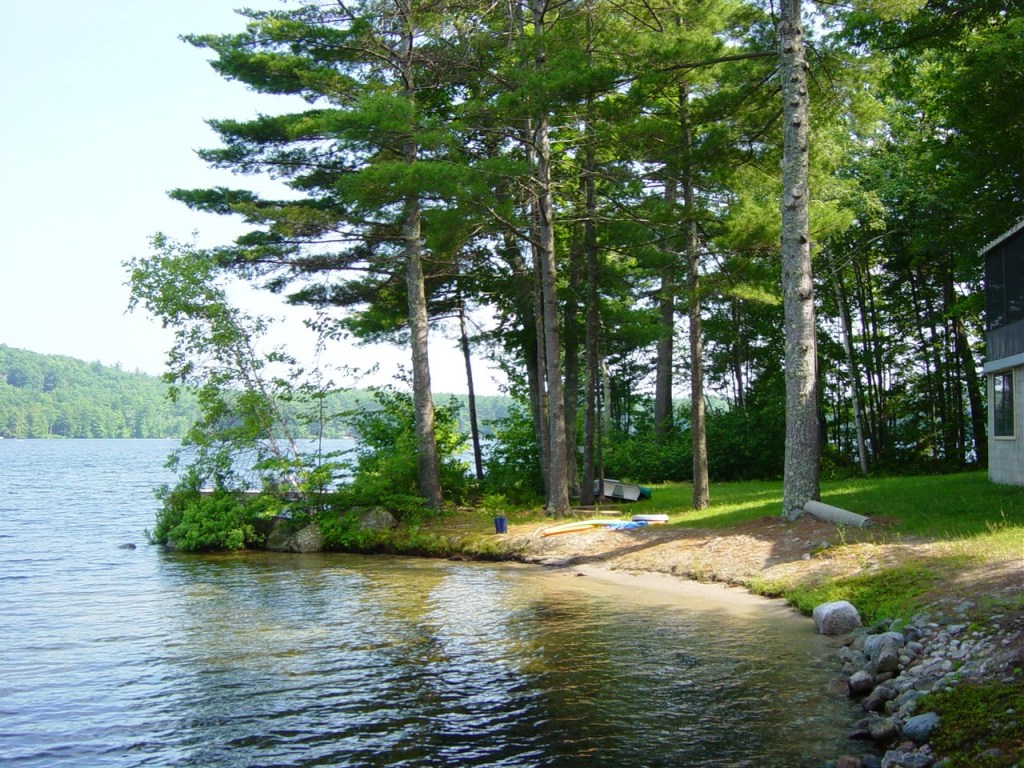
As I furnish my new office in our camp on Balch Lake, I ponder the wisdom of putting the picture of the beach at Parker Pond on my wall, the photograph that my late wife had blown up and framed for me. My new office here at the lake is a light green, similar to the color of my office at Parker Pond, but the green is just a little darker with more of hint of blue in it than the touch of yellow that the Parker Pond office had. Like that office, this new one has a ground-level window that looks right out at the lake, with a sense that you could reach your arm out and touch the water.
The photograph represents so many happy times, times with my late wife, times by myself there, times with family and friends. However, I can not yet look at the photograph of that lake without feeling its loss, and I do not want to be sad as I sit in my office and write. So I will wait.
My heart is not so easily given away as in those younger days, and, at this end of my life, I feel the shortness of time and a reluctance to embrace the expansive. But I have been given the gift of another day, and I will not let it lie unopened. Balch Lake offers possibilities, and I am eager to explore.
 Becoming Brynna
Wonderful!
Agree, camps on lakes hold wonderful family memories.
LikeLike
PLEASE keep writing. Your “ voice” is so distinctive and beautiful. . When u ask Ro if she minds having finished her book and she says “ not really” ( etc) I can HEAR her saying it! Open the gift of each day. It is also a gift to me! Love to u both. R
Sent from my phone
Rosalie J. Wolf
Botanica Capital Partners LLC
917 215 4247 cell
Rwolf@botanicacap.com
New York, NY. 10021
Westport CT 06880
LikeLiked by 1 person
Hi Brynna,This is beautifully written! Wonderful! You express yourself so well! I’m so happy you found a partner to love and share your life with! The lake sounds fabulous! You deserve the best! I wish you both happiness and a wonderful life together! Love,VerylSent from my iPad
LikeLike
What a powerful piece! Your reflections and writing transport us to a calm and beautiful place and time. Keep writing.
LikeLike
beautifully written and so reflective of who you are and how you have moved on.
LikeLike
Hello Brynna. It has been while since we were in touch and reading your recent post filled me with happiness. It is wonderful to know you that you got married again. I feel fortified just reading about lake life! Warmly, Laura
LikeLike